Influences Iranina Persian Art and Architecture Had on the World
Persian art and architecture in the present day is associated with the nation of Iran and usually designated as beginning with the Achaemenid Empire (c. 550-330 BCE) but has an even longer history with its origins dating back to before the Persians arrived on the Iranian Plateau old in the 3rd millennium BCE.
Persian fine art and compages was influenced early on by the older civilizations of Elam and Susiana in the region and by neighboring Mesopotamia. Early on Elamite artworks focused on depictions of animals and the use of geometric and imaginative designs and the art of Susa mirrored this paradigm just expanded upon it through the representations of dogs.
Dogs, in fact, seem to have been amongst the most popular artistic representations of Susiana. Awe-inspiring compages of this period is best exemplified in the site of Chogha Zanbil (earlier known as Dur Untash) with its towering ziggurat and walls and more than modest structures which exhibit the same care in design and structure; these same techniques and designs, minus the ziggurat, would afterward influence Persian works.
In c. 550 BCE, Cyrus the Great (r. c. 550-530 BCE) founded the Achaemenid Empire whose artistic works drew on the models of the past and improved upon them. The best instance of Achaemenid art and architecture are the ruins and works plant at Persepolis, the capital city planned and begun by Darius I (r. 522-486 BCE) and largely completed by his son Xerxes I (r. 486-465 BCE). Earlier Elamite structures – such as Chogha Zanbil – had been congenital of mud brick, but the Achaemenids worked primarily in stone with ornate bas-reliefs as ornamentation. Achaemenid jewelry was fashioned of precious metals – often gold – and gemstones, exhibiting an impressive level of craftsmanship.
Western farsi fine art reached its peak under the Sassanians whos created some of the greatest monuments and works of art of the ancient world.
Western farsi artistic momentum flagged during the time of the Seleucid Empire (312-63 BCE) but was revived during the Parthian Empire (247 BCE - 224 CE) and reached its peak under the Sassanians (224-651 CE) whose empire drew upon the vast history of its predecessors to create some of the greatest monuments and works of art of the aboriginal earth. After the autumn of the Sassanian Empire to the Islamic Arabs in 651 CE, Persian creative innovations continued to influence the art and compages of the Islamic world and, today, many of these are synonymous with the concept of Islamic Art.
Early Works of Elam & Susiana
For some few thousand years prior to the 3rd millennium BCE, the region of Susiana was inhabited past nomadic and semi-nomadic peoples who eventually settled and founded the metropolis of Susa around 4395 BCE. The Elamites were already in the region at this time, their settlement at Chogha Bonut dating to c. 7200 BCE. These peoples' lives on the Iranian Plateau were alternately influenced past the Sumerians of Mesopotamia and the tribes of the highlands of the Zagros mountains. Scholar Pierre Amiet notes:
when the people of the mountains and the plateau achieved unity in the 3rd millennium BCE, they were able to incorporate Susiana – with its highly developed urban civilization – into a powerful state, the first cultural and political entity recorded in the history of Islamic republic of iran: Elam. (Harper, 2)
By this fourth dimension, a type of art had already adult in the region which is now known every bit Proto-Elamite and focused chiefly on depictions of animals. Amiet notes, "Animals were ofttimes substituted for people, sometimes in apparently humorous scenes that perhaps evoked fables" (Harper, 3-4). By 5500 BCE, depictions of dogs were prevalent on ceramic vessels from sites in Khuzistan such as Chogha Mish and the site of Tepe Sabz in Deh Luran. The largest collection of domestic dog-ornamented ceramics has come from Susa which suggests a continuation of the Proto-Elamite preoccupation with representations of animals in art.
The Proto-Elamite Menstruum ended with encroachments from Mesopotamia during their Early Dynastic Period (2099-2334 BCE) and, especially, during the Dynastic III Period (2600-2334 BCE) when Sumerian kings similar Eannatum (c. 2500-2400 BCE) conquered Elam. Mesopotamian influence at this fourth dimension is axiomatic in statuary representing human being figures, nearly notably statuettes of worshippers placed in sanctuaries to stand for the spirit of communal devotion.
The Akkadian Empire took the region under Sargon of Akkad (r. 2334-2279 BCE) further advancing Mesopotamian motifs in the fine art of the region and, in architecture, this influence was manifest most conspicuously in the great building circuitous of Chogha Zanbil, built during the reign of Untash-Napirisha (r. c. 1340 BCE).
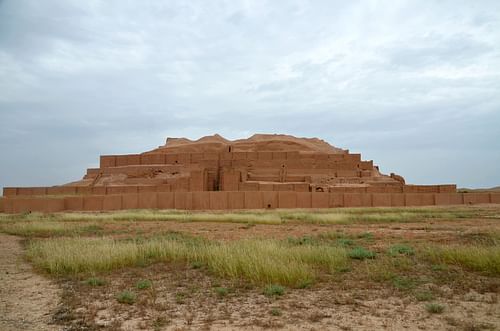
Chogha Zanbil Ziggurat, Iran
Chogha Zanbil is a Mesopotamian ziggurat surrounded by temples and encircled by a wall. Made of baked dirt bricks, and inscribed with Elamite phrases, praises, and curses, the complex – located 19 miles (30 kilometers) southeast of Susa – was an effort to unify the disparate regions of Elam in worship of the god Inshushinak, patron deity of Susa. Although certainly Elamite in grapheme, Chogha Zanbil drew on Mesopotamian motifs and methods of construction which would be developed afterward in Persian art and architecture. The influence of before Akkadian and Sumerian cylinder seals is as well evident in the artworks of Elam earlier than Chogha Zanbil - c. 2200 BCE - which depict assorted deities and human figures in communal scenes and these motifs would later be developed past the Persians.
Although the Persians had arrived by the 3rd millennium BCE, they were firmly settled by the 1st at Fars (Pars) shut to Elam, the expanse which would give them their name. When Cyrus the Swell founded the Achaemenid Empire in c. 550 BCE, he drew on the long-established civilization of the past – which, by this time likewise included Median contributions – to encourage what is now known as Persian art and compages.
Achaemenid Art & Architecture
The most famous artworks of the Achaemenid Empire come up from the collection known as the Oxus Treasure; a hoard of beautifully crafted works discovered c. 1877 CE cached in the northward bank of the Oxus River. This collection includes coins, bowls, figurines and statuettes, jewelry, jugs, and plaques of golden. Although the authenticity of a number of these items has been challenged in the past, the scholarly consensus presently is that they are all 18-carat artifacts from the Achaemenid catamenia, most probable taken from a nearby temple and buried for safety during one of the many turbulent periods of the region.
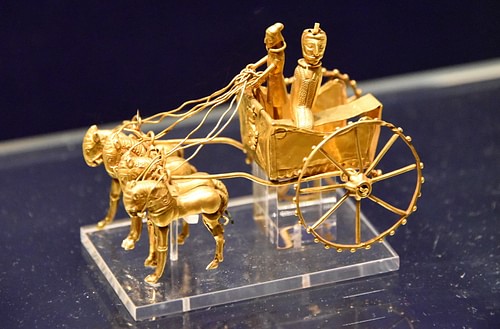
Egyptian Model Chariot
The intricacy of design and craftsmanship of some of the pieces demonstrates extraordinary skill in metallurgy, well-nigh notably in the armlets, statuettes, and a golden model of chariot with horses and figures. Even though this model is unfinished, the detail of the horses' harness, the wheels, and the ornamentation of the chariot itself would have required considerable endeavour and a high skill set.
In improver to the artifacts from the Oxus drove, many others have been establish in the ruins of cities such equally Persepolis and Susa and in excavated graves and tombs. These include plates, bowls, drinking vessels, amulets, and weapons among other items. A royal drinking vessel (rhyton) would exist quite ornate, often decorated with animal imagery or in the shape of a bull or goat. More common drinking vessels were bowls or shallow plates which seem to accept been cast as the floral motif on the bottom of the vessels is compatible on a number of them and is not duplicated within the vessel itself. Information technology is quite likely these types of bowls and plates were mass-produced for use likewise as trade, while jewelry, for the nearly part, was handmade and possibly commissioned by a specific royal personage.
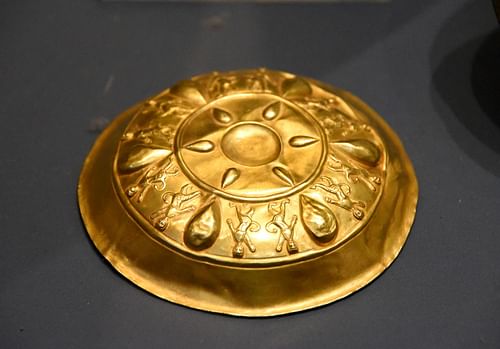
Golden Bowl from the Oxus Treasure
Cyrus the Neat was primarily concerned with consolidating his power and expanding his territories – although he no doubt busied himself as well with domestic matters – and his son and successor, Cambyses 2 (r. 530-522 BCE) followed this aforementioned course so it is non until the reign of Darius I that 1 finds any real attention paid to artistic and architectural development. Even so, Cyrus devoted considerable time and idea to his capital of Pasargadae, where, co-ordinate to Pierre Amiet,
He commissioned architecture of a deluxe blazon, intentionally rejecting an urban setting. Ii columned halls, which were really assembly halls for the Persian nobility and not residences, were integrated into a magnificent landscape in a vast, ingeniously arranged, and irrigated garden. (Harper, 13)
Gardens were integral to Western farsi architecture and featured prominently in design. The Persian word for garden – pairi-daeza – gives English its word paradise because these landscapes were designed so beautifully as to be most otherworldly. Cyrus is said to have spent as much time as possible in his gardens, most likely to clear his listen before addressing state matters. The gardens were irrigated past the qanat system – sloping channels which brought water upward from under the footing – and large plots of flora and fauna were given a prominent place in the fundamental courtyards of palaces and administrative buildings.
Easily the all-time-known artwork from the Achaemenid Period is the Cyrus Cylinder, a piece of work in dirt inscribed with Cyrus the Bully'south genealogy and vision for his empire. This piece has recently been cited every bit the showtime statement in history setting forth a proclamation of human rights and guaranteeing freedom of religion and practice for the people of the empire. It should be noted, all the same, that this interpretation has been challenged.
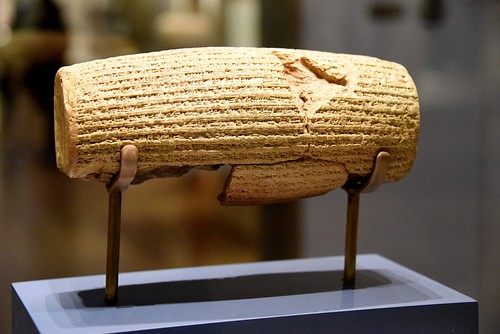
The Cyrus Cylinder
When Darius I came to power, he rebuilt Susa, adding a palace complex to the site, and followed the same paradigm as Cyrus had in featuring elaborate gardens as primal to the design. In his buildings at Susa and Persepolis, Darius I'due south artisans initiated the motif of the "Persian animal capital" – the effigy of a bull or a bird at the top of a column – and also designed these columns equally slender pieces which would describe the eye upwards to the capital figure while likewise accentuating the grandeur of the tiptop of the building. The columns, then, were non just artworks in and of themselves just fully integrated into the overall impression of the structure. Postal service-and-Axle construction was used for the roof, which – at Persepolis – was made of cedar from the forests of Lebanon.
At Persepolis, Darius I also initiated the practice of ornamentation by bas-relief. The almost famous bas-relief at Persepolis shows the many unlike people of the Achaemenid Empire arriving to pay homage to the Farsi emperor, and these images are so detailed that the nationality of each individual is easily discerned every bit are the gifts they are shown bringing as offerings. The reliefs at Persepolis – and the examples of the votive plaques in the Oxus collection and found elsewhere – all show attention to form and detail which enlivens the images and makes them almost seem in move.
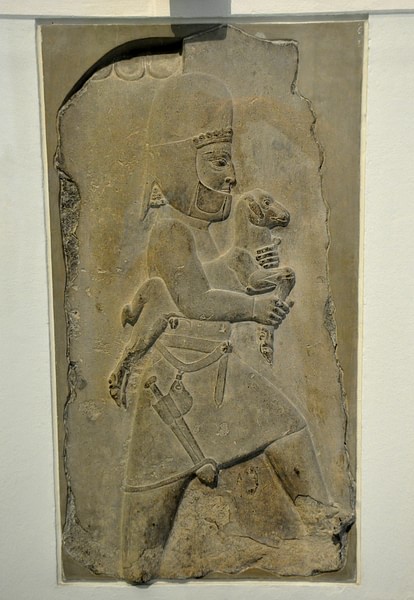
Gift-bearer Property a Lamb from Persepolis
This attention to detail seems to have too characterized the gardens of the Achaemenids and, by extension, all of their art. This same can certainly be said of the artworks of other civilizations, and the Achaemenids freely drew on Greek, Median, and other elements in the cosmos of their ain; but Achaemenid art and compages is chiefly characterized by a single, almost overwhelming, effect of the whole existence greater than any of the sum of its parts.
The Parthian Flow
The Achaemenid Empire fell to Alexander the Nifty in 330 BCE and was replaced past the Seleucid Empire nether Seleucus I Nicator (r. 305-281 BCE), one of Alexander's generals. The Seleucids maintained the before structures simply, every bit Greeks, naturally pursued their own artistic vision and created in their own style. In 247 BCE, their empire vicious to the Parthians, and Farsi art and compages resumed development. This is not to say no progress at all was made during the time of the Seleucids, just the kinds of innovation and detail of the before empire do not announced during this time.
The Parthians were a semi-nomadic people initially, and their art reflects the various regions they had come in contact with. Although they retained the nuts of Achaemenid artworks, their vision was expressed in circularity in compages and frontality in art. The bas-reliefs of the Achaemenids – featuring images of people from the side – were replaced past statuary and images which run into a viewer face-to-face. One excellent example of this is the frontal bas-relief of a Parthian male monarch offering cede to the god Heracles-Verethragna, patron god of royal dynasties, soon housed in room 310 of the Louvre Museum, Paris, French republic. The rex holds a cornucopia in his left arm while his right offers a sacrifice at a Fire Chantry. This image, like many, once adorned a temple dedicated to the god and the use of frontality would accept brought a visitor into direct contact with the image of the rex, offering one a chance of communion with a fellow supplicant from the past.
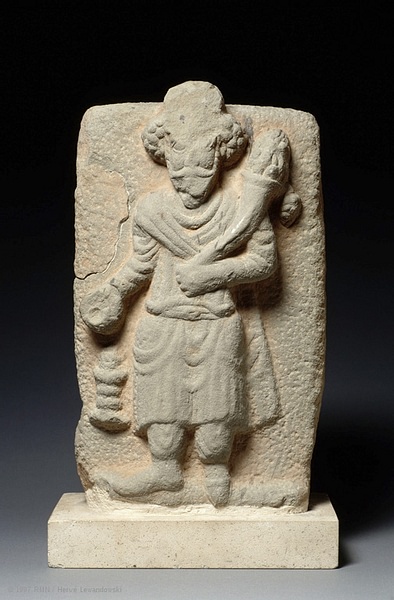
Parthian King Offering Cede
Scholar Homa Katouzian points out that Parthian art and architecture was influenced past "Achaemenid, Hellenistic, and Mesopotamian forms, tempered past their own nomadic traditions" but they drew on these influences to brand the fine art uniquely their own (45). The utilize of the dome was already a staple of Roman art, for example, but the Parthians took this concept and expanded upon it. Roman domes were situated on the tops of structures; Parthian domes rose from the globe, accentuating superlative every bit well every bit strength and stability, cartoon the heart upwards and directly back down to the ground. A company to their capital of Nisa could take continued the line of the dome, imaginatively, into the world and back up to form a circle and the circumvolve-motif featured in almost all Parthian works of fine art and compages, symbolizing abyss.
Sassanian Art & Architecture
The Sassanian Empire continued these innovations and, similar the others before them, learned from and drew upon multiple influences. The brilliance of the Sassanians was their ability to fully integrate what had worked in the past into their nowadays efforts and improve upon it. Sassanian art is the pinnacle of Western farsi artistic try in the same way that the Sassanian Empire as a whole exemplified the greatest aspects of ancient Persian culture.
The Sassanian Empire was founded by Ardashir I (r. 224-240 CE) who had been a full general under the Parthians earlier he overthrew the final Parthian king and established his own dynasty. Ardashir I nearly instantly initiated the building projects which remain the all-time examples of Sassanian art. Under Ardashir I – and developed further under his son and successor Shapur I (r. 240-270 CE) – the dome and minaret became staples in architectural design. The Parthian motif of frontality in bas-reliefs was abandoned in favor of the Achaemenid treatment of images in profile or three-quarter view.
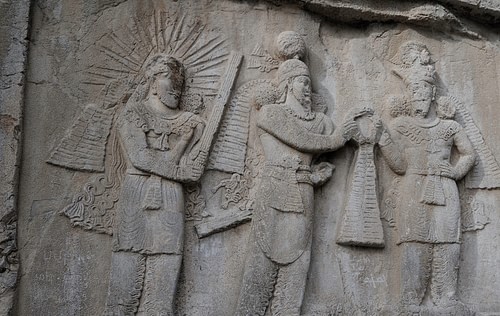
Victory Monument of Ardashir I
The Sassanians drew on both the Parthian and Roman dome and arch techniques to create arch-supported structures which still conveyed the concept of circularity. The best example of this is the famous palace at Ctesiphon known every bit Taq Kasra – probably built by Kosrau I (r. 531-579 CE) though sometimes attributed to Shapur I – which features the largest single-span vaulted arch of unreinforced brickwork in the world, unequaled anywhere even in the present day. The ruins, nonetheless extant, were the entryway to a grand imperial palace - as Ctesiphon was the Sassanian majuscule – which was congenital to mirror the grandeur of Achaemenid masterpieces similar Persepolis.
Sassanian fine art kept the floral motifs of the Achaemenids and the circularity of the Parthians just enhanced their works with images of the chase, dances, parties, and other pastimes too as scenes of battle, religious motifs, and mythological tales. These figures are nearly always depicted in contour although some – such every bit those on silver plates and drinking vessels – are frontal. The greatest and all-time-known example of frontal Sassanian art is the colossal statue of Shapur I which stands 21 feet (half-dozen.7 meters), carved from a single stalagmite in the Shapur Cave in Iran. Even in ruin, the statue still breathes life and its immense height conspicuously impresses upon a visitor the grandeur of its subject.
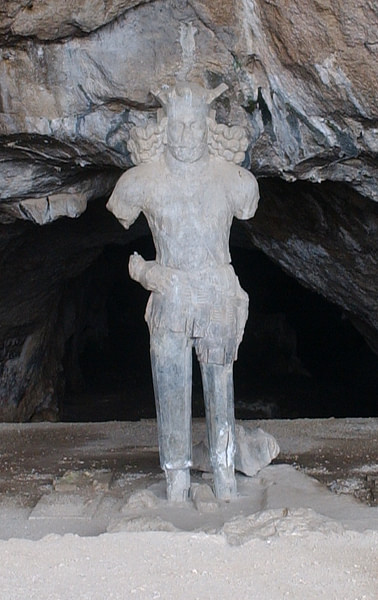
Jumbo Statue of Shapur I
Decision
The rise of Islam is the 7th century CE and the subsequent conquest of various regions by Muslim Arabs led inevitably to the fall of the Sassanian Empire in 651 CE. The ancient Persian religion of Zoroastrianism was suppressed – as were many other aspects of Persian culture – in an effort to firmly establish an Islamic-Arabian worldview. Notwithstanding, Persian art and architecture endured and came to influence after Islamic-Arabian works. The minaret, almost synonymous with Islamic architecture in the present day, is – every bit noted – a Sassanian innovation. Homa Katouzian notes:
From the beginning of the Arab conquest, Iranians were involved in the new regime, whether as converted warriors, local administrators, scribes, or later every bit viziers, linguists, poets, literati, intellectuals, rebels, and eventually founders of new dynasties…The loss of the Sassanian Empire was not synonymous with the demise of the Iranians who, fifty-fifty in the first two centuries after the conquest and before the foundation of Farsi dynasties, played a decisive role in the internationalization of Islamic social club and civilization. (67)
Persian art and compages continues to exert a powerful influence in the present day equally information technology honors the traditions of the past in taking what worked well before and improving upon it. Persian architects and artists today are keenly aware of their heritage – some artisans even continuing to piece of work in metals as their ancestors did thousands of years ago – and depict on their history to preserve and award the past. Persian ceramics, rugs, bronze, and textiles continue to be among the most popular in the world, an enduring legacy of ane of the greatest of all the ancient civilizations.
This article has been reviewed for accurateness, reliability and adherence to bookish standards prior to publication.
Source: https://www.worldhistory.org/Ancient_Persian_Art_and_Architecture/
0 Response to "Influences Iranina Persian Art and Architecture Had on the World"
Post a Comment